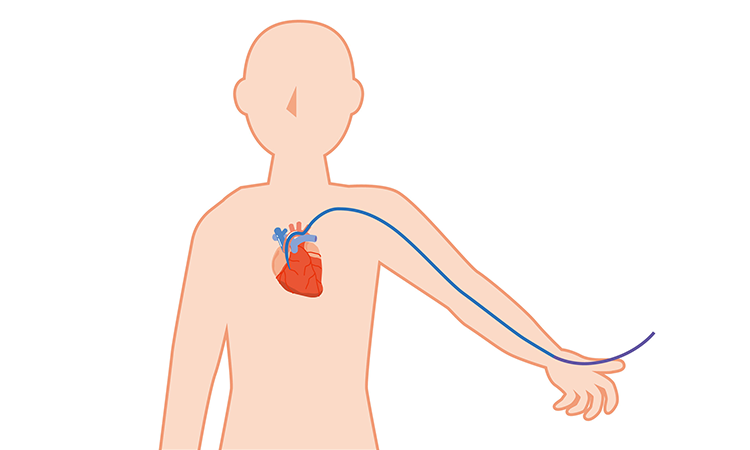
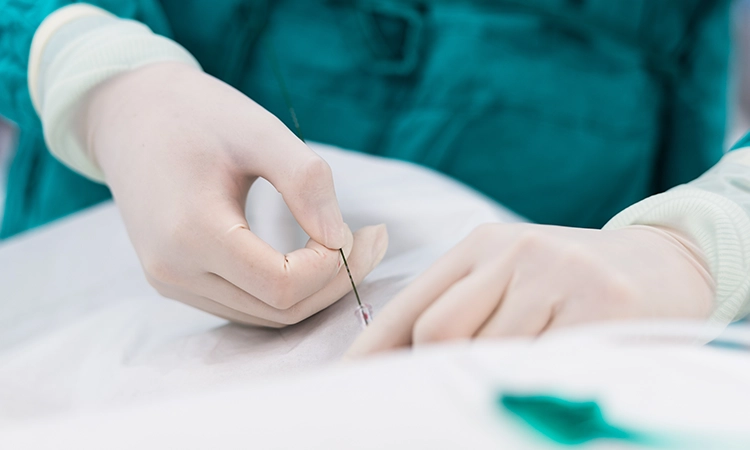
Guidewires are used in endovascular and endoscopic procedures to help guide catheters and other medical devices to the intended location. Guidewires vary by type in terms of construction, surface treatment, and handling characteristics, requiring appropriate selection according to the procedure and treatment target.
This article explains the roles, types, and uses of guidewires, focusing primarily on those used in endovascular procedures.
What Is a Guidewire? Key Roles Explained
A guidewire is a medical wire, typically made of stainless steel or nickel-titanium alloy, with a diameter ranging from 0.01 to 0.04 inches (approximately 0.254 to 1.016 mm). Its surface is coated with a hydrophilic material that reduces friction within the blood vessels and facilitates smooth insertion. Guidewires are characterized by the flexibility needed to navigate complex pathways, such as blood vessels, and by excellent torque transmission that conveys rotational movement from the proximal end to the distal tip.
Guidewires serve the following roles:
- Creating Access to the Target Site
- Guidewires are used to cross difficult areas, such as stenotic lesions, and establish a pathway for catheters and other interventional devices to reach the target site.
- Facilitating Device Delivery
- Once access is established, guidewires provide a pathway for the safe delivery of catheters, balloons, stents, and other interventional devices to the target site.
- Enhancing Visibility Under Fluoroscopy
- Guidewires coated with radiopaque materials or equipped with radiopaque tip markers improve visibility under fluoroscopy, enabling accurate device positioning.
Types of Guidewires
Guidewires are broadly categorized into two main types: "coil-type" and "polymer-jacket" guidewires.
Coil-type guidewires consist of an inner metal core wrapped in a platinum or gold coil, with some models featuring hydrophilic or hydrophobic surface coatings. They offer excellent handling characteristics and tactile feedback from the distal tip, making them highly versatile across a wide range of procedures.
Polymer-jacket guidewires feature a polymer outer jacket, typically with a hydrophilic coating. Their lubricious surface facilitates navigation through tortuous vessels and calcified lesions, although care should be taken due to the risk of perforation.
Guidewires are also available in various tip configurations (straight or angled), diameters (0.01 - 0.04 inches), lengths (standard or short), as well as different levels of stiffness and coating coverage. The appropriate guidewire is selected based on the specific procedure and compatibility with the devices being used.
How to Use a Guidewire
Basic guidewire manipulation consists of advancing and withdrawing the guidewire, as well as rotating it to change its direction. By combining these movements, the guidewire can be accurately guided to the desired location. Shaping, in which the tip of the guidewire is bent slightly before use, is also important for facilitating directional control.
During use, guidewires are typically handled with saline-moistened gauze to help prevent contamination and drying. Dedicated torque devices may also be used to assist guidewire manipulation. Because guidewires are extremely long, racks or clips may be used to help prevent them from falling or becoming contaminated during use.
Partner with Nissha for Medical Device Manufacturing
Nissha offers contract manufacturing services for a broad range of medical devices, including guidewires, catheters, and endoscopic instruments. Leveraging an ISO Class 7 (Class 10,000) cleanroom at our Global Headquarters in Kyoto, we maintain a quality management system that complies with ISO 13485 and applicable QMS regulations. We are also capable of supporting compliance with global regulatory requirements, including those of the FDA and MDSAP.
Whether launching a new product or transferring and expanding existing production lines, Nissha provides integrated manufacturing services designed with global expansion in mind.
For more information, please visit Nissha's Medical Device Contract Manufacturing page.
References
・Guidewire (Japanese) | J-STAGE: https://www.jstage.jst.go.jp/article/jsvs/33/5/33_24-00056/_pdf/-char/ja
・Tips and Troubleshooting for Operating the Guide Wire During ERCP (Japanese) | J-STAGE: https://www.jstage.jst.go.jp/article/gee/65/3/65_271/_pdf