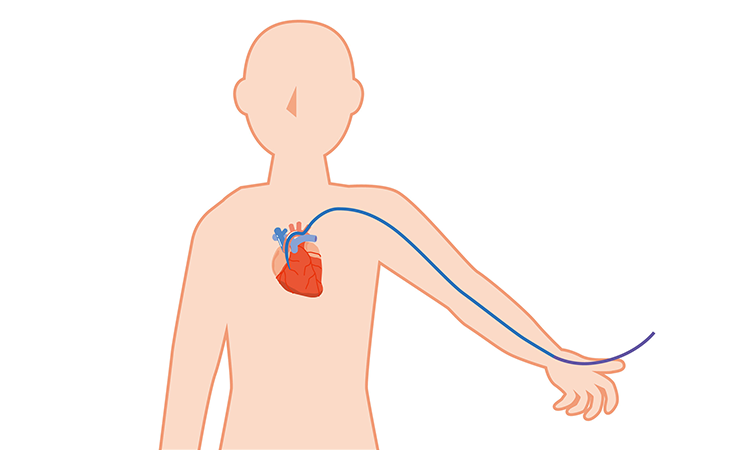
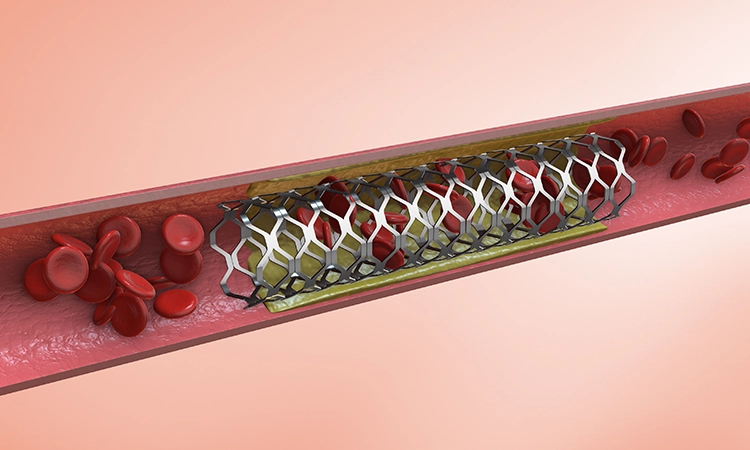
As atherosclerosis progresses, the coronary arteries that supply blood to the heart muscle may narrow, leading to angina or myocardial infarction. One treatment option is percutaneous coronary intervention (PCI), commonly known as coronary angioplasty, in which a balloon is used to widen the narrowed artery and a stent is inserted to help keep the artery open. The stent used in this procedure is called a coronary stent.
This article explains what coronary stents are, their history and types, and important considerations following stent placement.
What Is a Coronary Stent?
A coronary stent is a medical device used to treat the narrowing of coronary arteries, which can lead to conditions such as angina or myocardial infarction. Coronary stents are manufactured in several designs, including tubular, coil, and mesh configurations. Their structures are typically made from materials such as stainless steel, tantalum, or Nitinol, and typically measure 2 to 3 mm in diameter and 20 to 30 mm in length.
Most coronary stents are expanded and placed using a balloon. Some stents made from shape-memory Nitinol, however, are implanted in a compressed state and expand naturally at body temperature. In recent years, drug-eluting stents (DES), which release medication to help prevent restenosis, have become increasingly common.
History of Coronary Stents
The name “stent” and part of the concept behind it are said to originate from a dental material used in reconstructive surgery for facial injuries that were common during World War I. Charles Stent, a London dentist, mixed a base material with gutta-percha, a rubber-like substance, to adjust its strength and color, and popularized it under the name “stent”. This is believed to have inspired the development of modern coronary stents.
Compared with coronary artery bypass surgery (CABG), coronary stent treatment requires smaller incisions and shorter hospital stays, reducing the burden on patients, and has become widely used worldwide.
However, early coronary stents had a major limitation. In approximately 20 to 30% of cases, neointimal tissue developed within six to eight months, causing the artery to narrow again, a phenomenon known as restenosis. To address this issue, drug-eluting stents coated with antiproliferative drugs were developed. Today, they are widely used in the treatment of severe angina or myocardial infarction.
What Happens After Stent Placement?
After a coronary stent is placed, patients need to take antiplatelet medication to help prevent blood clots from forming inside the stent. These medications reduce platelet aggregation and increase the risk of bleeding complications, which may increase the risks associated with surgery and anesthesia.
Immediately after treatment, patients typically take two antiplatelet medications together. Major surgery may be postponed during this period because of the increased risk of bleeding. If emergency surgery is required, medications or anesthesia plans may be adjusted, and the cardiologist, surgeon, and anesthesiologist will work with the patient to determine the most appropriate approach.
There is still a risk of restenosis, so it is important to continue taking prescribed medications as directed. Ongoing treatment and management of underlying conditions such as high blood pressure and high cholesterol are also important, as these conditions can increase the risk of angina or myocardial infarction.
Common Types of Coronary Stents
Coronary stents can be divided into two types: bare-metal stents and drug-eluting stents (DES), which are coated with medication.
Drug-eluting stents are now the standard choice in most coronary interventions because of their lower restenosis rates. Bare-metal stents are used less frequently and may be selected in specific clinical situations. With either type, antiplatelet medication is necessary to prevent blood clots. While bare-metal stents are effective at widening the vessel, they do not suppress the healing response of the vessel wall, which can lead to restenosis in approximately 20 to 30% of cases. However, patients with bare-metal stents may require a shorter duration of dual antiplatelet therapy in some cases.
Drug-eluting stents were developed to address this issue. By suppressing the vessel’s healing response, they can help reduce the restenosis rate to less than 10%. However, patients need to continue taking antiplatelet medication for a longer period.
The choice of stent depends on factors such as the condition and diameter of the vessel, as well as the patient’s age, comorbidities, and other individual circumstances.
Partner with Nissha for Medical Device Manufacturing
Nissha offers contract manufacturing services for a broad range of medical devices, with a focus on single-use devices, including catheters, tubes, endoscopic treatment instruments, and surgical devices.
Our facilities in Kyoto, Japan, include ISO Class 7 (Class 10,000) cleanrooms and operate in compliance with ISO 13485 and applicable QMS requirements. We are also capable of supporting the manufacture of specially controlled medical devices.
Through our Innovation Center and manufacturing facilities at our Global Headquarters in Kyoto, we provide integrated support spanning research and development, manufacturing, packaging, coordination of sterilization through qualified external partners, and final product distribution.
For more information, please visit Nissha's Medical Device Contract Manufacturing page.