Joint pain and limited joint movement can make everyday activities such as walking, standing up, and getting dressed more difficult, significantly affecting quality of life. When conditions such as osteoarthritis, rheumatoid arthritis, or post-traumatic joint deformities progress, nonsurgical treatments may no longer provide sufficient relief. In such cases, joint replacement surgery is one of the main surgical treatment options.
Artificial joints are medical devices designed with joint anatomy and expected loading conditions in mind. Their development has progressed alongside advances in materials science and clinical medicine.
This article explores the structure, materials, and history of artificial joints and provides an overview of joint replacement surgery, including the conditions for which it may be considered and the different types of procedures.
What Is an Artificial Joint?
An artificial joint is a medical device used to replace damaged or worn joint surfaces and help restore joint function. Artificial joints may be used when conditions such as osteoarthritis, rheumatoid arthritis, or post-traumatic deformities cause severe pain or limit the range of motion. They are most commonly used in hip and knee replacement procedures but may also be used in shoulder, elbow, ankle, and other joint replacements.
Structure of Artificial Joints
Artificial joints consist of multiple components designed to replicate the anatomy of a natural joint while supporting both load transmission and movement.
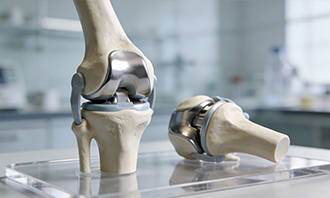
In total knee arthroplasty (TKA), a typical system includes a femoral component, a tibial component, and a polyethylene insert positioned between them. Depending on the implant design, a patellar component may also be included.
In total hip arthroplasty (THA), the artificial joint consists of implant components including a stem inserted into the femur, a femoral head attached to the stem, and an acetabular cup and liner placed on the pelvic side. The implant components can be secured with or without bone cement. In cementless systems, surface treatments such as porous coatings are used to promote bone ingrowth.
Artificial joint components are individually optimized with consideration for mechanical strength, wear characteristics, and fixation to bone.
Materials Used in Artificial Joints
Artificial joints are made from materials selected for their biocompatibility, wear resistance, and corrosion resistance.
Titanium alloys and cobalt-chromium alloys are among the most commonly used metals. Titanium alloys are often used in bone-contacting components such as hip stems because of their compatibility with bone and relatively low weight. Cobalt-chromium alloys offer high wear resistance, making them well suited for articulating surfaces.
Ultra-high-molecular-weight polyethylene (UHMWPE) is widely used for bearing surfaces. In recent years, modified forms of polyethylene, including vitamin E-stabilized polyethylene, have been developed to reduce oxidative degradation. Ceramic materials may also be used in components such as femoral heads in hip replacements to help reduce wear-particle generation.
Artificial joint components are evaluated for safety and performance using applicable standards and regulatory requirements in each target market, with consideration given to their intended long-term use.
History of Artificial Joints
The development of artificial joints began in the late 19th century and has progressed alongside advances in materials science and clinical medicine.
Early attempts at joint reconstruction used materials such as celluloid, ivory, silver, and zinc. However, limitations in durability and infection control made them unsuitable for long-term use.
The foundations of modern artificial joint design were established in the 1960s. Subsequent developments, including improvements in ultra-high-molecular-weight polyethylene (UHMWPE) and the introduction of cobalt-chromium and titanium alloys, led to significant improvements in wear resistance and biocompatibility.
Today, artificial joints are developed with long-term use in mind, and the number of joint replacement procedures has increased as populations age. The evolution of artificial joints reflects the continued integration of materials science and clinical medicine.
What Is Joint Replacement Surgery?
Joint replacement surgery involves replacing a joint that has been severely damaged by disease or injury with an artificial joint.
During the procedure, worn cartilage and damaged or deformed bone surfaces are removed and replaced with implant components made of materials such as metal, polyethylene, and ceramic. The primary goals of the procedure are to relieve severe pain, improve joint function, and help the patient return to daily activities.
In Japan, joint replacement surgery is widely performed, particularly on the hip and knee. Advances in implant materials and surgical techniques have improved the long-term durability of artificial joints, and joint replacement may now be considered for a broader range of patients, including some younger patients.
Because an artificial joint is a mechanical structure, maintaining muscle strength and following postoperative guidance are important for supporting recovery and long-term function.
Conditions for Which Joint Replacement Surgery May Be Considered
Joint replacement surgery may be considered for conditions such as osteoarthritis, rheumatoid arthritis, osteonecrosis of the femoral head, and post-traumatic arthritis.
Osteoarthritis is the most common condition leading to joint replacement. Aging and years of stress on the joint can gradually wear away the articular cartilage, which can lead to severe pain as the bones come into direct contact. In the knee, osteoarthritis is often accompanied by bow-legged or knock-kneed alignment and may make walking or climbing stairs difficult.
Hip osteoarthritis is one of the main conditions treated with hip replacement surgery. In Japan, many cases are considered to be associated with acetabular dysplasia. As the condition progresses, it can cause a difference in leg length and reduced range of motion, significantly affecting quality of life.
In the shoulder, joint replacement may be considered for osteoarthritis accompanied by a rotator cuff tear. Other conditions that may be treated with joint replacement include rheumatoid arthritis or deformity following a comminuted fracture in the elbow, as well as post-traumatic osteoarthritis in the ankle.
Regardless of the joint affected, nonsurgical treatments such as medication and exercise therapy are generally tried first. Surgery may be considered when pain persists and substantially interferes with daily activities. The decision to proceed with surgery is made after considering factors such as imaging findings, pain severity, activity level, and overall health.
Types of Joint Replacement Surgery
Joint replacement procedures vary depending on the joint being treated, including the knee, hip, shoulder, elbow, ankle, and finger joints. The design of the implant and the method used to secure it are selected based on the structure of the joint and the extent of joint damage.
Knee replacement
In knee replacement surgery, damaged joint surfaces are replaced with components made of metal and polyethylene. The procedure can help relieve pain and improve joint function.
Success rates of more than 90% at over 15 years after surgery have been reported, and more than 90,000 procedures are performed annually in Japan. Although complications such as infection and deep vein thrombosis may occur, knee replacement is generally considered a safe and effective procedure.
Hip replacement
Hip replacement surgery replaces the damaged parts of the hip joint with components made from materials such as metal, polyethylene, and ceramic. Advances in materials and surgical techniques have extended the longevity of hip implants, and 20-year implant survival rates of more than 80% have been reported.
Shoulder replacement
Reverse total shoulder arthroplasty has become more widely used in Japan since 2014 and can help relieve pain and improve the ability to lift the arm.
The procedure carries risks such as dislocation and infection and is used primarily in older patients with rotator cuff dysfunction. When the rotator cuff remains functional, conventional total shoulder arthroplasty may also be considered and can support functional recovery.
Elbow replacement
Elbow replacement may be performed for conditions such as rheumatoid arthritis or comminuted fractures. The damaged joint is replaced with a metal component on the humeral side and a plastic component on the ulnar side.
Elbow implants are broadly classified as semi-constrained or unconstrained. Implant survival rates of 85–90% at 10 years have been reported. However, revision surgery may be required, and elbow replacement is a specialized procedure.
Ankle replacement
Ankle replacement may be performed to treat conditions such as ankle osteoarthritis. Approximately 400 procedures are performed annually in Japan, primarily at specialized medical centers.
Implant survival rates of 70–85% at 10 years have been reported. Although complications such as infection and implant loosening may occur, ankle replacement can help relieve pain and improve quality of life.
Finger joint replacement
The development of artificial finger joints has been challenging due to the small size of the joints and the complexity of the surrounding soft tissues.
A hinged metal implant was introduced in 1958 but gradually fell out of use because of its high complication rate. In 1964, Swanson introduced a one-piece flexible implant made of silicone elastomer, a design that remains widely used today.
References
・What Are Artificial Joints? (Japanese) | The Japanese Society for Replacement Arthroplasty (JSRA): 人工関節とは | 日本人工関節学会
Partner with Nissha for Medical Device Manufacturing
Artificial joints are medical devices designed to restore damaged joint function, relieve pain, and improve mobility. Bringing these devices to market requires not only strong R&D capabilities but also manufacturing expertise and support for regulatory requirements across global markets.
Nissha provides contract manufacturing solutions that help medical device companies focus on R&D, scale production globally, and build more resilient supply chains. With an integrated manufacturing network, approximately 6,000 m² of cleanroom space, an ISO 13485- and MDSAP-certified quality management system, and experience supporting compliance with FDA regulations, Nissha is equipped to support medical device projects for markets worldwide.
For more information, please visit Nissha's Medical Device Contract Manufacturing page.